Time spent at a rapid charger often matters more than a car’s headline power figure. An 800-volt system promises an advantage here: it can transfer high power at lower current. Yet doubling voltage does not automatically double charging speed. The outcome depends on the battery, cooling, power electronics and charging station working together.
What do 400 and 800 volts actually mean?
These are voltage classes for the traction battery and high-voltage system. Actual battery voltage changes with state of charge; an “800-volt” car does not operate at exactly 800 volts all the time. The number does not describe energy capacity: an 80 kWh battery can store 80 kWh in either voltage class. Cell connections and the electronics designed around them make the difference.
The garage’s three-phase 400-volt AC supply is a separate concept. During AC charging, the car’s onboard charger converts the supply for the battery. Smaller electrical consumers can use a separate low-voltage network; the “800 V” label does not mean every cabin device operates at that voltage.
The real advantage: less current for the same power
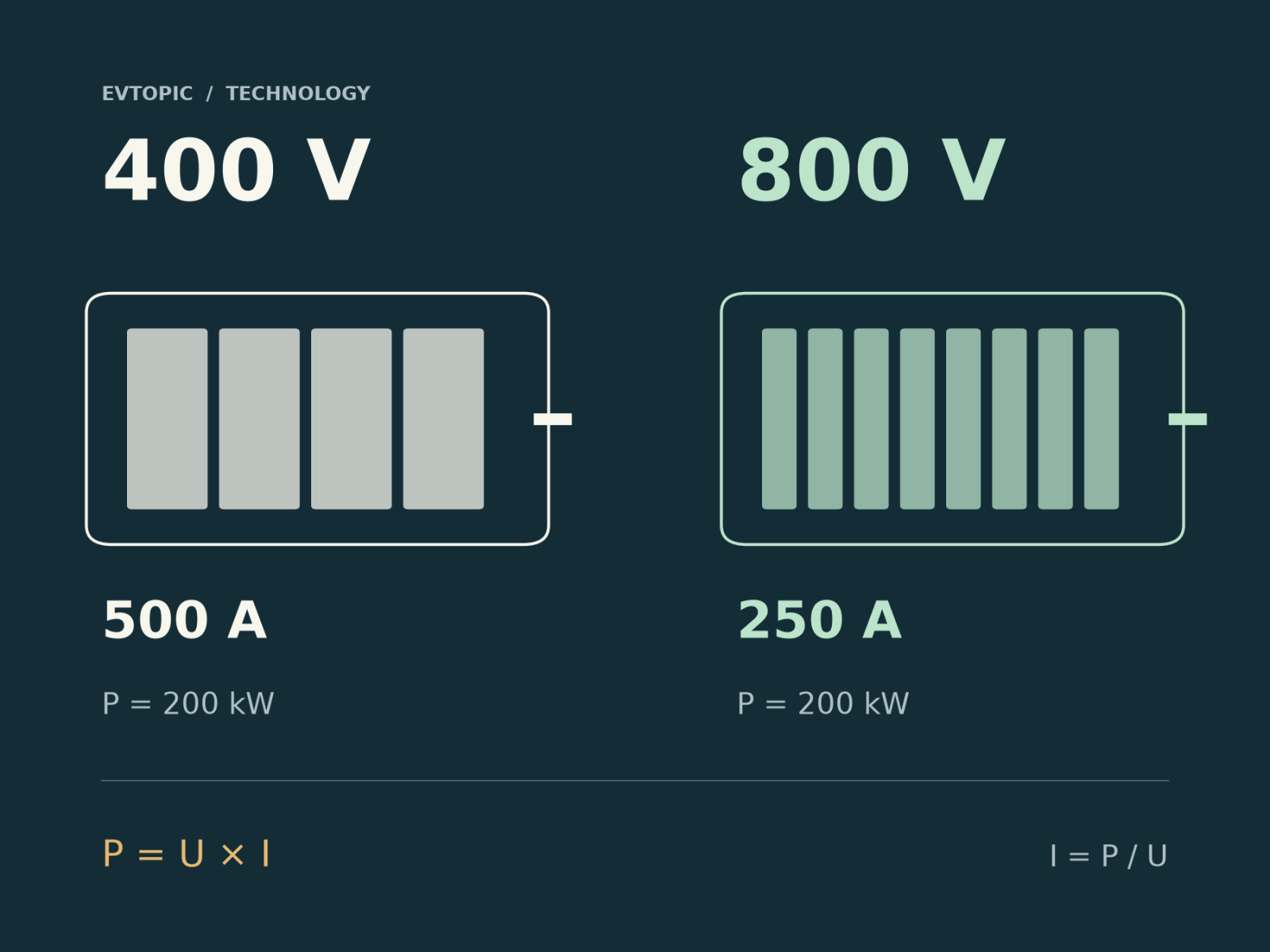
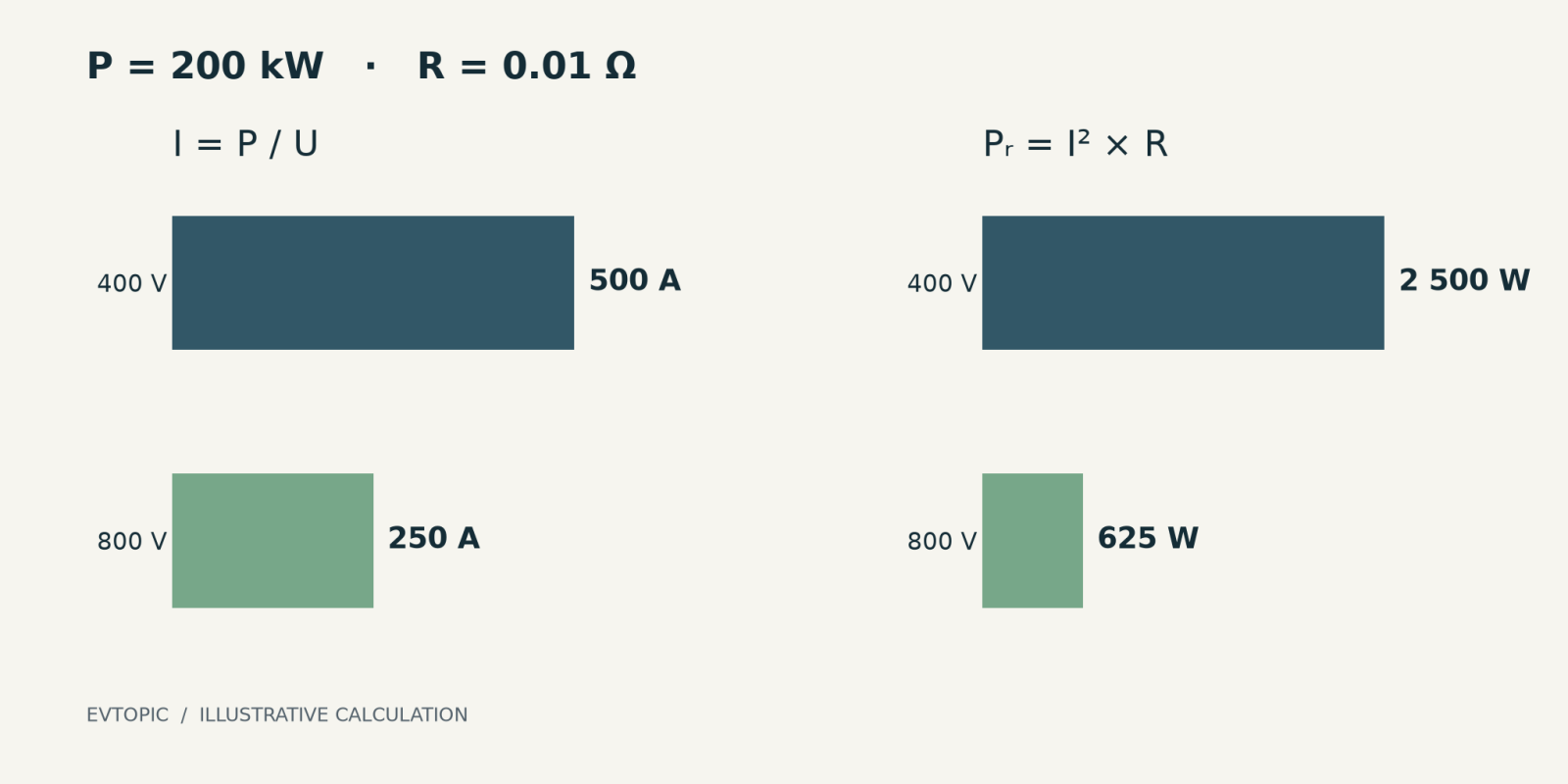
For DC, the basic relationship is P = U × I: power equals voltage multiplied by current. At an illustrative operating point of 200 kW, 400 V requires 500 A, while 800 V requires 250 A. The power transferred is the same, at half the current. This comparison describes a particular DC path, not every current flowing inside the motor.
Resistive heating in a conductor is I² × R. If the same path has a resistance of 0.01 ohm, the example produces 625 W of heat instead of 2,500 W: one quarter as much. That is a 75 per cent reduction in this one path with unchanged resistance, not a 75 per cent improvement in total vehicle losses or consumption. Engineers may trade some of that margin for thinner, lighter conductors, in which case resistance changes.
The benefit cannot simply be applied to individual cells. Rearranging the same cells into more series connections and fewer parallel branches can reduce pack current while leaving each cell’s load unchanged. Cell heating, charging rate and ageing therefore need to be assessed alongside chemistry, pack topology and thermal management.
Why does this help rapid charging?
A charger is constrained by maximum voltage, current and total power together. An imaginary 500 A station could supply 200 kW at 400 V or theoretically 400 kW at 800 V — if its own power limit, cable and the car permit it. A 350 kW charger still cannot supply 400 kW. The peak rating on its casing is not necessarily available at every battery voltage.
The battery imposes limits too: when cold, highly charged or overheated, it may request less power. Consequently, average power and elapsed time from 10 to 80 per cent, plus usable range added in that time, are more informative than a brief peak. A car that charges rapidly but consumes a lot of energy may have a smaller advantage on the road than its charging display suggests.
For example, 70 per cent of an 80 kWh usable capacity is 56 kWh. Adding that energy at an average of 100 kW theoretically takes 33.6 minutes, or 16.8 minutes at 200 kW, ignoring losses here. This illustrates the effect of average power; neither the 400- nor the 800-volt label guarantees either result.
What happens at a lower-voltage charger?
An 800-volt battery needs a way to accommodate a lower-voltage DC source. At the E-GMP launch, Hyundai described a system using the motor and inverter to boost a 400-volt input. It provides compatibility without a separate external adapter. Available charging power must still be checked for the specific model. Hyundai: E-GMP technical introduction
Another approach reconfigures the battery: Porsche’s electric Macan launch documentation describes two 400-volt halves that can charge in parallel at up to 135 kW. Documentation for the updated 2024 Taycan instead specifies a booster enabling up to 150 kW at 400-volt stations, versus up to 320 kW at suitable 800-volt DC chargers. Compatibility therefore does not mean equal speed. Porsche: Macan battery and charging; Porsche: updated Taycan charging
At home, the onboard charger sets the pace
An 800-volt drivetrain does not turn an 11 kW AC connection into 22 kW charging. The grid supply, wallbox and onboard charger determine the result together. The Porsche documents above also describe 11 kW AC charging: the same car capable of high-power DC charging accepts much less power at home. For someone charging mainly overnight, higher battery voltage alone offers little day-to-day time saving.
Higher voltage brings engineering costs
An 800-volt system needs suitably rated semiconductors, switching devices, insulation and monitoring. It must also allow margin for switching transients. Infineon, for example, describes 1,200-volt SiC devices for 800-volt automotive systems, while Texas Instruments discusses the isolation requirements. These are development and component requirements, not proof that every 800-volt car is more expensive overall or less safe. Infineon: 1,200 V automotive devices; TI: isolation in 800 V systems
Benefits of silicon carbide, or SiC, should not all be attributed to 800 volts: it is a semiconductor technology that can also be used in 400-volt systems. Final cost and efficiency depend on the whole drivetrain. Savings in cabling or cooling may offset some electronics cost, while repairability depends on the actual design and parts availability. Infineon: SiC and voltage level in the drivetrain
Advantages and limits at a glance
| Consideration | 400 V | 800 V |
|---|---|---|
| Transferring high power | Requires more current. | Less current for the same power. |
| Conductors and heat loss | High current may require thicker conductors or more cooling. | Scope for lower losses or lighter conductors. |
| DC rapid charging | The station’s current limit can become a bottleneck sooner. | More headroom if the cells and station can support it. |
| Lower-voltage DC station | Voltage range and current limit still matter. | Adaptation is needed; speed depends on the model. |
| Home AC charging | Limited by onboard charger and supply. | Also limited by onboard charger and supply. |
| Design requirements | Lower voltage ratings may suffice. | Higher voltage ratings and appropriate insulation are needed. |
| Range and battery life | Depend on the whole vehicle and its cells. | Voltage alone guarantees no improvement. |
When does it really matter?
On frequent long motorway trips with suitable rapid chargers, a well-executed 800-volt system can offer a tangible advantage. For urban use with regular home charging, a good 400-volt car can meet the same needs. Compare the specific version’s 10–80 per cent time, battery preconditioning, consumption and chargers on your usual routes together. Higher voltage is a useful engineering tool; the whole vehicle determines the benefit in use.
Sources6
- Hyundai Motor Group: E-GMP technical launch, 2020
- Porsche: updated Taycan range and charging, 2024 press kit
- Porsche: electric Macan battery and charging, launch press kit
- Texas Instruments: isolation and 800 V architectures (SSZT071)
- Infineon: 1200 V CoolSiC MOSFETs for automotive applications
- Infineon: effects of SiC traction inverters on the EV drivetrain