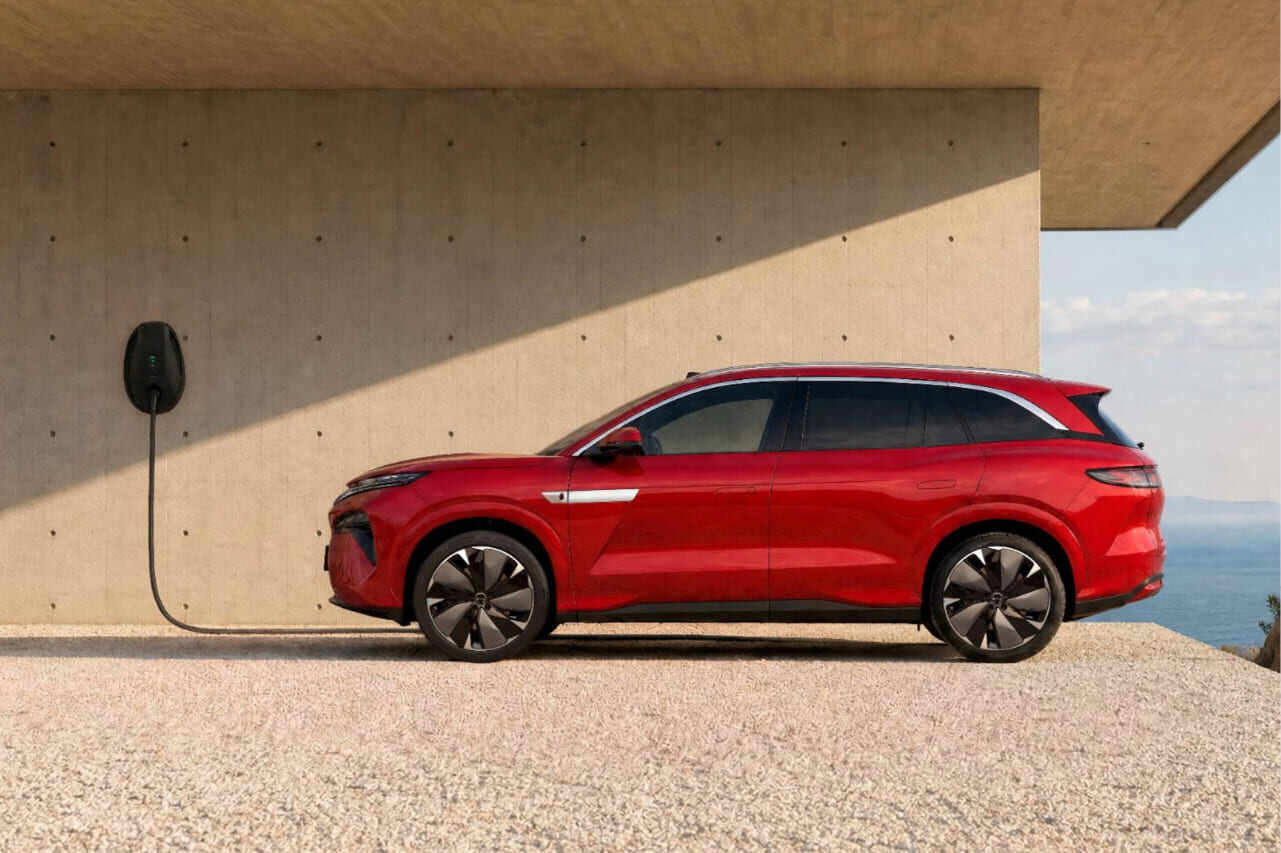
A van blocking a narrow street, a pedestrian stepping out behind it and a cyclist further ahead: imagine an ordinary urban encounter like this. A driving assistant would earn its value by helping in a clear, predictable way. More revealing than a polished demonstration would be its behaviour when the next move becomes uncertain. Denza’s latest announcement provides a useful starting point for asking that question.
In its 12 October release, Denza says CNOA urban driving assistance is planned for Europe in 2027, through an OTA update starting with the Z9GT. The company describes pre-installed hardware including one LiDAR and 11 cameras. Local adaptation and approval under R171 remain part of the introduction process, and the driver retains responsibility. This is a manufacturer’s plan, not the result of an EVTopic road test. CNOA stands for City Navigation on Driving Assistant. The announcement also promises stopping at traffic lights, negotiating roundabouts and changing lanes around obstacles. Source
Four separate questions behind one announcement
For a buyer, installed hardware, completed software, an approved function and a service actually available on their car are different questions. The table below is our own reading guide: it identifies the evidence we would look for behind each claim. It is not Denza’s internal development schedule and does not assert that any particular step has been completed.
| Question | What evidence would we look for? |
|---|---|
| What is fitted to the car? | The specification and technical documentation for that version. |
| What can the system do? | A precise feature list, operating limits and user instructions. |
| What has been approved? | Documentation covering the relevant function and vehicle version. |
| What does the owner receive? | Country, vehicle variant, software version, timing and any charge. |
A smooth turn by a demonstration car might tell us something about the first two questions. It would still take separate evidence to establish that the same feature will be usable in the version we intend to buy, in our own country. “The hardware is already fitted” is useful information, but insufficient on its own for a purchasing decision. What matters is how that capability becomes a service and where the conditions are recorded for the buyer.
Controlling the car and understanding traffic
The Z9GT’s European launch material associates the e³ platform with three-motor propulsion, independent rear-wheel steering and Vehicle Motion Control. It describes both battery-electric and plug-in hybrid versions. These are manufacturer-described vehicle capabilities: they influence how the car can move. Interpreting its surroundings and selecting an appropriate manoeuvre require a separate assessment. Source
Consider an avoidance manoeuvre. One task is to execute a precise steering movement; another is to decide whether moving out is appropriate at all. That decision might depend on approaching traffic or a portion of road hidden from view. In our reading, an agile chassis or a striking parking demonstration therefore cannot answer every question about urban driving. Mechanical and sensing capabilities become useful when the decision is appropriate too.
The driver’s role defines the distinction
NHTSA’s explanation distinguishes Level 2 assistance, which can combine steering with acceleration and braking while the driver continuously supervises, from Level 3. At Level 3, the engaged system performs the driving task, but the driver must be available to take over when requested. The distinction concerns how the task is shared, not whether a particular manoeuvre looks impressive. This is conceptual background, not a certification of Denza’s system. Source
That leads to a practical question: what remains my task after I press the activation button? If the answer is unclear, the assistant’s name will not resolve it. For us, convenience would mean making fewer small adjustments while retaining a clear understanding of the driving situation. We would look for an experience in which the driver does not have to guess what the car currently expects of them.
Where R171 fits into the story
UNECE’s explanation of R171 describes DCAS as sustained longitudinal and lateral assistance that does not take over the entire driving task. It also addresses driver engagement, warning strategies and manufacturers’ obligation to communicate system limitations clearly at purchase and through their communications. The controls and the explanation given to the user are therefore part of the safety question, alongside the vehicle’s behaviour. Source
EU Regulation 2025/1122 incorporated R171 into the relevant vehicle-safety framework, applying an “if fitted” compliance condition to systems assisting the driver with dynamic vehicle control. That is general regulatory context. Approval of a particular Denza feature would need its own supporting documentation; the existence of a regulation is not itself approval of a product. Source
The published R171 text deals specifically with system boundaries. Manufacturers must describe operating conditions and the strategy for notifying the driver as those limits are reached. When a recognised boundary is exceeded, termination of the affected assistance must remain controllable for the driver. The document also addresses advance notification when approaching a limit and the driver’s potential reaction time. How assistance ends matters as well as how it starts. Source
Three revealing moments in an urban evaluation
In a future evaluation organised under appropriate conditions, EVTopic would pay attention to the following ordinary situations. These are editorial assessment questions, not claims about Denza’s current performance or suggestions to create hazardous situations. Alongside successful manoeuvres, we would record communication: what the car indicates, when it does so and how clearly the message can be understood.
Occlusion. A parked vehicle temporarily hides part of the scene. We would ask whether that uncertainty results in cautious, predictable movement. A changed road layout. Roadworks move the usable lane. Is it clear to the driver what assistance remains available? An interrupted manoeuvre. Traffic changes while a movement is being planned. Does the system communicate its revised intention clearly, and does the vehicle’s motion match that message? In none of these cases would one good or bad moment justify a general verdict.
Capability needs a safety back-up
Euro NCAP’s assisted-driving assessment considers the balance between vehicle assistance and driver engagement, together with Safety Backup. The latter includes what happens when the driver does not respond, misuses the system or encounters its operating limits. These gradings are published separately from the star rating. The methodology is a useful reference, but cannot substitute for testing the particular European version of CNOA. Source
We would therefore separate impressions from evidence in a future assessment. Smooth braking may be pleasant, but a short drive cannot establish a general safety advantage. A useful comparison would record the route, conditions, exact vehicle and software versions, and the criteria used. We would not automatically transfer a result from a different model or an earlier software release to this system.
A software update is part of the product
UNECE’s explanation of cybersecurity and software-update regulation links connected vehicles to manufacturer management processes, performance requirements and auditing. Software-update management is treated as a specific responsibility. Updating a driving function is therefore more than a download: the manufacturer’s process and its auditability matter too. This is general background, not an audit of Denza’s update process. Source
As owners, we would want to know how to establish whether our car is eligible for an update and where to find an explanation of the changed functions. Whether an update alters operating conditions, the interface or the price of the service is a separate question. We do not invent product answers here: these are issues for the offer and documentation available in the relevant market to resolve.
What would make it valuable in daily use?
What makes the interest around Denza worthwhile for us is the prospect of improving urban driving in very concrete situations. We would expect a useful assistant to support the driver while preserving their understanding of the situation. We should know what to expect and recognise in time when conditions change. When the European feature actually becomes available, that predictability will be worth setting alongside the brochure: it is the quality that could matter most in everyday use.
Sources8
- DENZA: intelligent driving assistance planned for Europe in 2027
- DENZA Z9GT: European launch and e3 platform
- NHTSA: automated vehicle safety and automation levels
- UNECE: introduction of UN Regulation 171 on DCAS
- Commission Delegated Regulation (EU) 2025/1122
- UN Regulation 171: system boundaries and controllability
- Euro NCAP: assisted driving assessment and separate gradings
- UNECE: cybersecurity and software update management