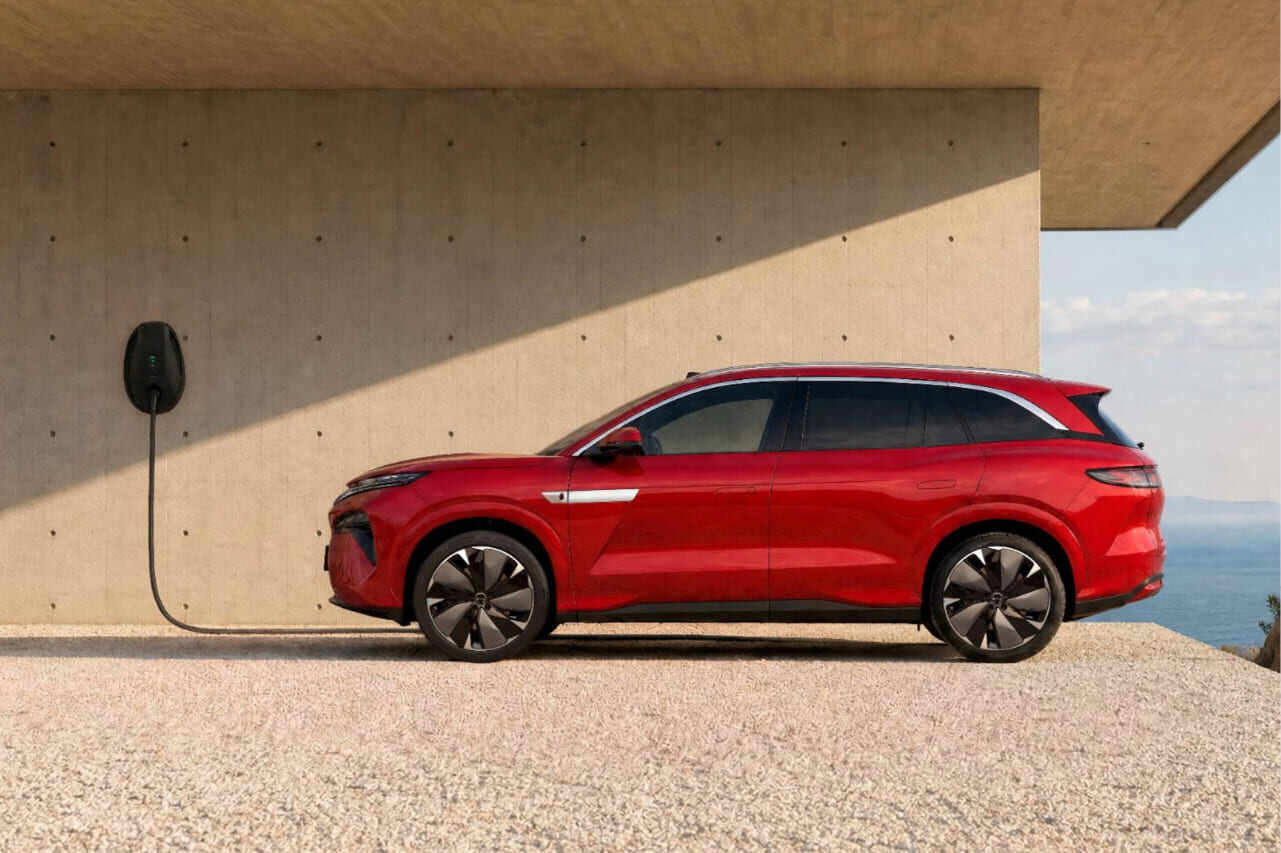
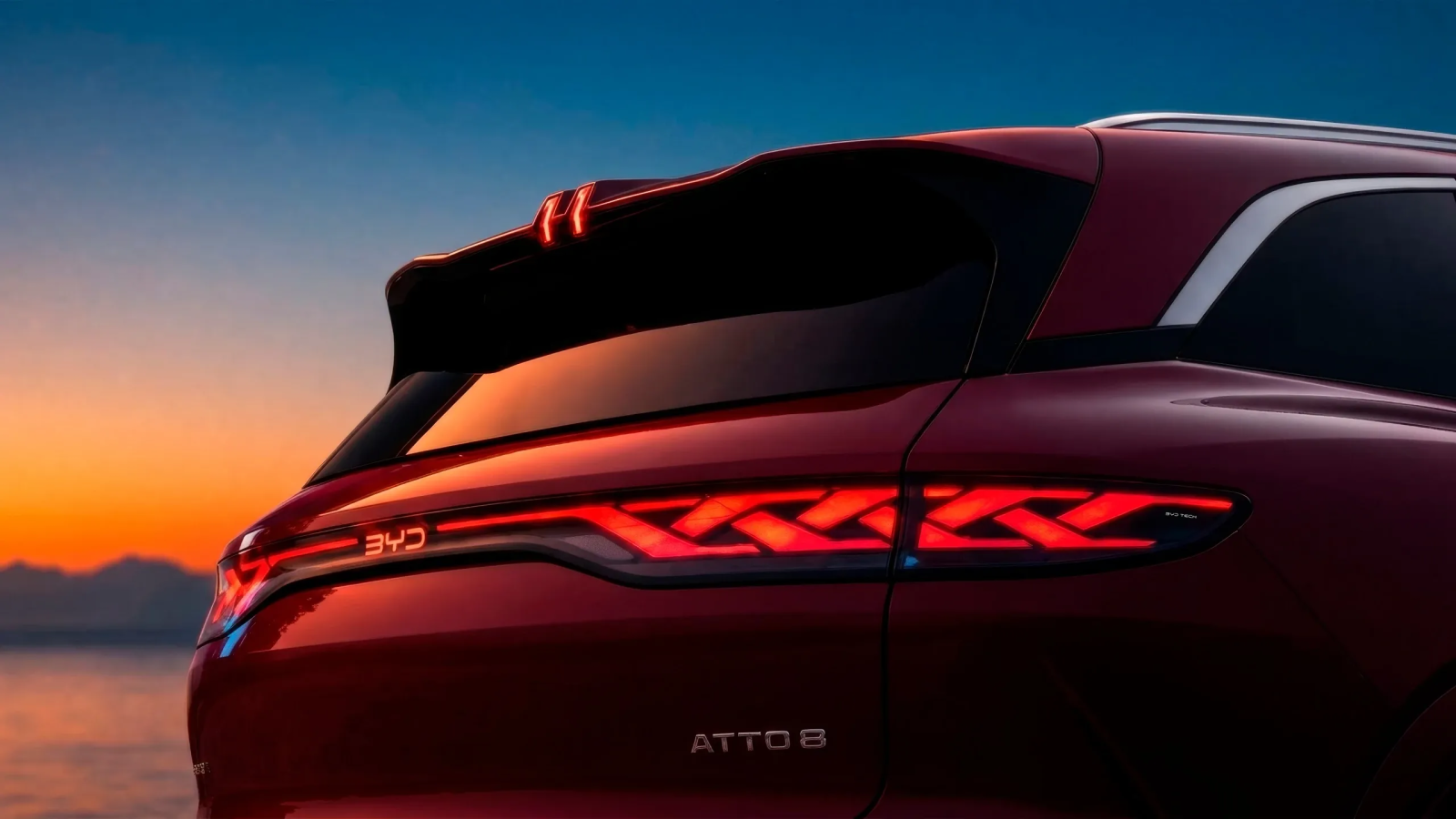
Five metres, seven seats and a large battery: at first glance, the new BYD ATTO 8 follows a familiar family-SUV recipe. The more interesting question raised by its Paris debut is how long drivers will spend charging on a journey. The second-generation Blade Battery puts that question at the centre of the story.
BYD unveiled its European flagship SUV at the Paris Motor Show on 12 October 2026. European sales are planned for the first quarter of 2027: this is a reveal, rather than confirmation of Hungarian customer deliveries. The release does not give a Hungarian price. Manufacturer announcement
Which ATTO 8 is this?
The name alone is not enough. In South Africa, ATTO 8 also denotes a plug-in hybrid with a 19 or 35.6 kWh battery. The newly revealed European model is fully electric, with a 115 kWh Blade Battery 2.0. Specifications for the hybrid sold in another market must not be substituted for those of this European EV. South African manufacturer specification
Two powertrains, the same battery capacity
| Manufacturer figure | Design RWD | Excellence AWD |
|---|---|---|
| Drive | Rear-wheel | All-wheel |
| Maximum power | 340 kW / 462 PS | 570 kW / 775 PS |
| Torque | 365 Nm | 775 Nm |
| 0–100 km/h | 8.0 s | 4.6 s |
| Stated battery capacity | 115 kWh | 115 kWh |
| WLTP combined, up to | 653 km | 602 km |
Source: BYD technical release in Italian. These are manufacturer figures at the reveal; the German release says consumption and emissions data remain under assessment. WLTP is not a promise of motorway or winter range. The source states a 115 kWh capacity without establishing that this is net usable energy.
At 5040 × 1996 × 1760 mm, this is a large vehicle. BYD states 270 litres of luggage space with seven seats in use, rising to 1960 litres with rows two and three folded, plus a 136-litre front compartment. The front seats and outer second-row seats offer heating, ventilation and massage. Manufacturer equipment details

Blade 2.0: what changed inside the battery?
The Blade name refers to long, flat cells and their arrangement within a pack. The original design also targeted packaging efficiency: cell-to-pack construction allocates less space to intermediate structures. That is a construction principle rather than a new battery chemistry. Original manufacturer Blade announcement
The second generation retains lithium iron phosphate, or LFP, within the lithium-ion battery family. BYD claims a 5% increase in energy density over the first generation. That alone does not establish a 5% range improvement in every vehicle: mass, aerodynamic drag and the chosen pack size also matter. Blade 2.0
To understand fast charging, look inside a cell. During charging, lithium ions travel from the positive electrode through the electrolyte towards the negative electrode, while electrons follow the external circuit. A charger cannot simply pour energy in: the electrode materials and the ion-conducting medium between them must accommodate that rate. Battery fundamentals — DOE
BYD addresses that internal process with FlashPass. Its description names three components: the Flash-Release cathode has a particle architecture designed to ease ion release; the Flash-Flow electrolyte targets faster ion conduction; and the Flash-Intercalate anode facilitates insertion into graphite. BYD also describes aligned graphite particles in the anode. The shared aim is lower internal resistance and less heat generation. Manufacturer technology explanation
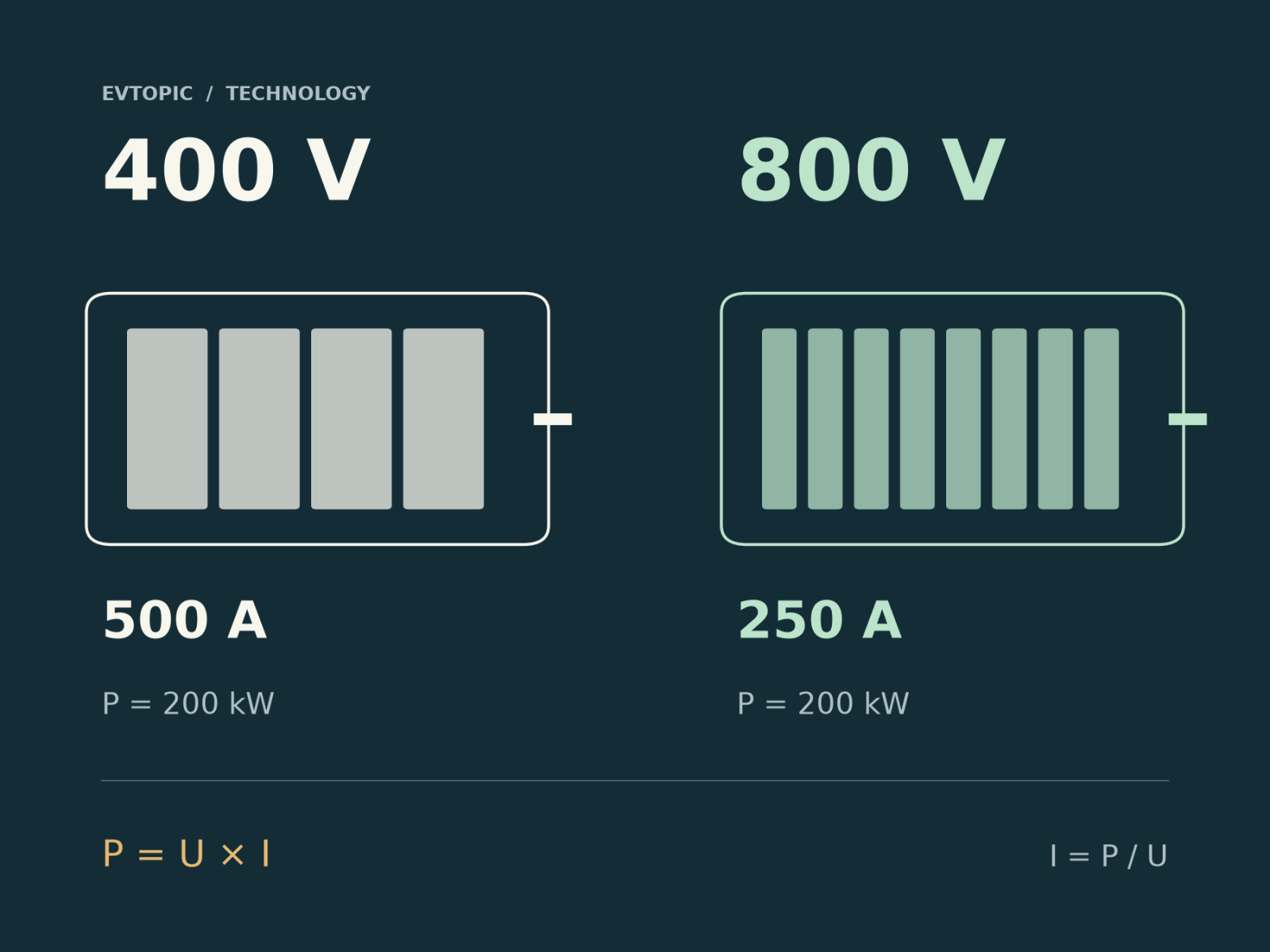
Simple physics illustrates why this matters: resistive heat increases with the square of current, following P = I²R. Reducing resistance becomes particularly valuable at high charging currents. A real cell is not just a resistor, however: electrochemical processes and temperature impose additional limits. This equation is an illustration, not a complete model of BYD’s cell.
An SEI layer does not make this a solid-state battery
BYD also highlights a thin, dense, dynamically regenerating SEI layer. The term denotes a solid interfacial layer between electrode and electrolyte; the intended balance is good ion transport with chemical stability. Manufacturer explanation A solid-state battery, by contrast, uses a solid electrolyte. Mentioning a thin solid interfacial layer does not establish that the entire electrolyte has been replaced with a solid. DOE: battery types
BYD reports a combined charging and nail-penetration test after 500 FLASH cycles, without smoke, fire or thermal runaway. These are manufacturer test claims, not results of our own testing. The 500 cycles describe preconditioning for that test, rather than the battery’s entire lifespan or the terms of a Hungarian warranty. BYD test description
What do five, nine and twelve minutes actually mean?
BYD combines the cell developments with intelligent thermal management. Manufacturer announcement. In practical terms, high power requires both suitable battery thermal conditions and a suitable charger. The quoted cold-weather result is not a promise that any cold-soaked car will immediately reproduce it on any charging point. FLASH figures concern DC fast charging; they do not automatically turn home AC charging into a nine-minute process.
| State-of-charge window | Claimed time | Condition |
|---|---|---|
| 10–70% | 5 minutes | FLASH Charging |
| 10–97% | 9 minutes | FLASH Charging |
| 20–97% | 12 minutes | −30 °C, FLASH Charging |
The figures above come from the ATTO 8 announcement. The “full in nine” slogan therefore means 97%, not 100%; the cold test also begins at 20%. These are different state-of-charge windows. BYD’s 1500 kW single-connector charger rating in the March release refers to the Chinese specification. It does not establish that the European ATTO 8 sustains that power or that every European charger supplies it. Charger specification
A calculation that puts the megawatts in context
Our approximate calculation: taking the stated 115 kWh as the reference, the 10–70% window represents 69 kWh. Over five minutes, that corresponds to approximately 828 kW average power stored in the battery. The 10–97% window represents 100.05 kWh, or approximately 667 kW over nine minutes. This assumes the displayed percentage is proportional to that energy capacity and ignores losses. Because net capacity is not established, these are illustrative estimates, not measured charging curves or certified grid-energy figures.
The different averages show why a single peak rating is insufficient. A nine-minute stop depends on the whole charging curve. Delivering the same estimated 69 kWh at an imaginary, constant 350 kW would take at least 11.8 minutes even without losses. That is a mathematical lower bound for this example, not a measured ATTO 8 result on a 350 kW charger.
The battery also needs a charging network
BYD targets 3000 European FLASH charging stations by the end of 2027. This is a rollout goal, not the size of today’s operating network. Its station concept also uses local energy storage: a buffer battery can charge more slowly and briefly deliver higher power. European plan, station concept. A buffer changes the timing of energy delivery; the energy it supplies must subsequently be replenished.
What should a real-world test establish?
The ATTO 8’s most interesting promise is the combination of a large family car with a short charging stop. Its value will depend on accessible FLASH sites, the actual charging curve, winter and motorway consumption, and usable space with seven seats occupied. Without Hungarian pricing and local launch details, a value-for-money verdict would be premature. Blade 2.0’s engineering direction is clear: ion transport and thermal management must both support the charger’s headline numbers if those numbers are to become shorter stops.
This article is based on manufacturer press material checked on 15 October 2026 and explicitly labelled calculations; it is not a road test. March battery-technology announcements are distinguished from October European model specifications. Chinese CLTC figures above 1000 km for other models are not the European ATTO 8’s WLTP range.
Sources11
- BYD: ATTO 8 European premiere — Paris, 12 October 2026
- BYD Italia: ATTO 8, European versions and cabin
- BYD España: ATTO 8 and European FLASH Charging rollout
- BYD: Blade Battery 2.0 — FlashPass, electrodes and SEI
- BYD España: Blade Battery 2.0 technical announcement, March 2026
- BYD Italia: Blade Battery 2.0, safety tests and FLASH infrastructure
- BYD: second-generation Blade Battery, thermal management, 6 March 2026
- BYD: original Blade Battery and cell-to-pack construction
- BYD South Africa: ATTO 8 PHEV specification sheet, April 2026
- US Department of Energy: DOE Explains — Batteries
- US Department of Energy: Breaking It Down — Next-Generation Batteries