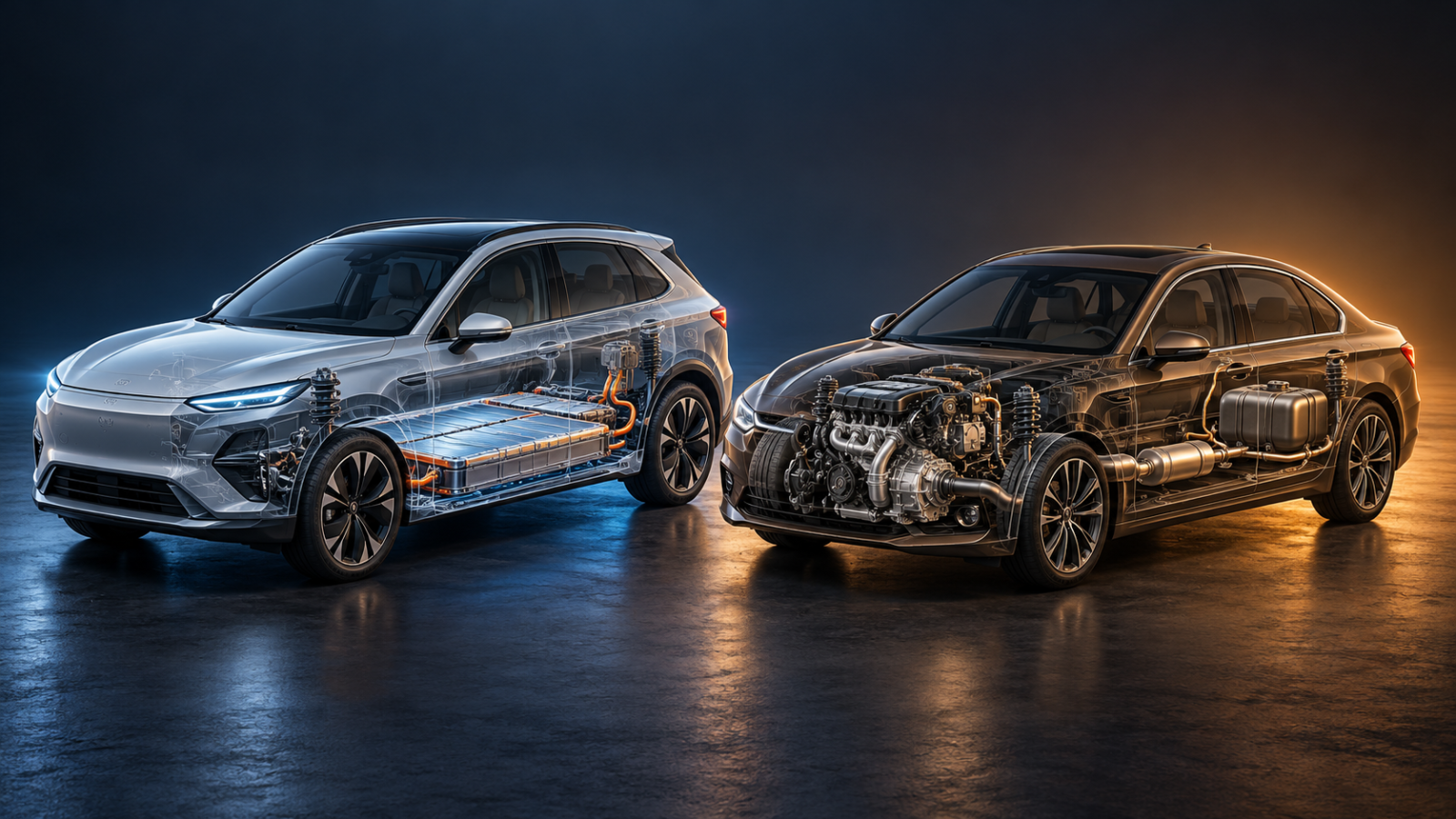
Solid-state batteries are often presented as the route to lighter electric cars, longer journeys and much shorter charging stops. The defining change is specific: the electrolyte that carries ions inside the cell is solid. Turning that change into a better vehicle also requires suitable electrodes, reliable interfaces and a manufacturing process that works at scale.
What is solid, and how does a conventional battery work?
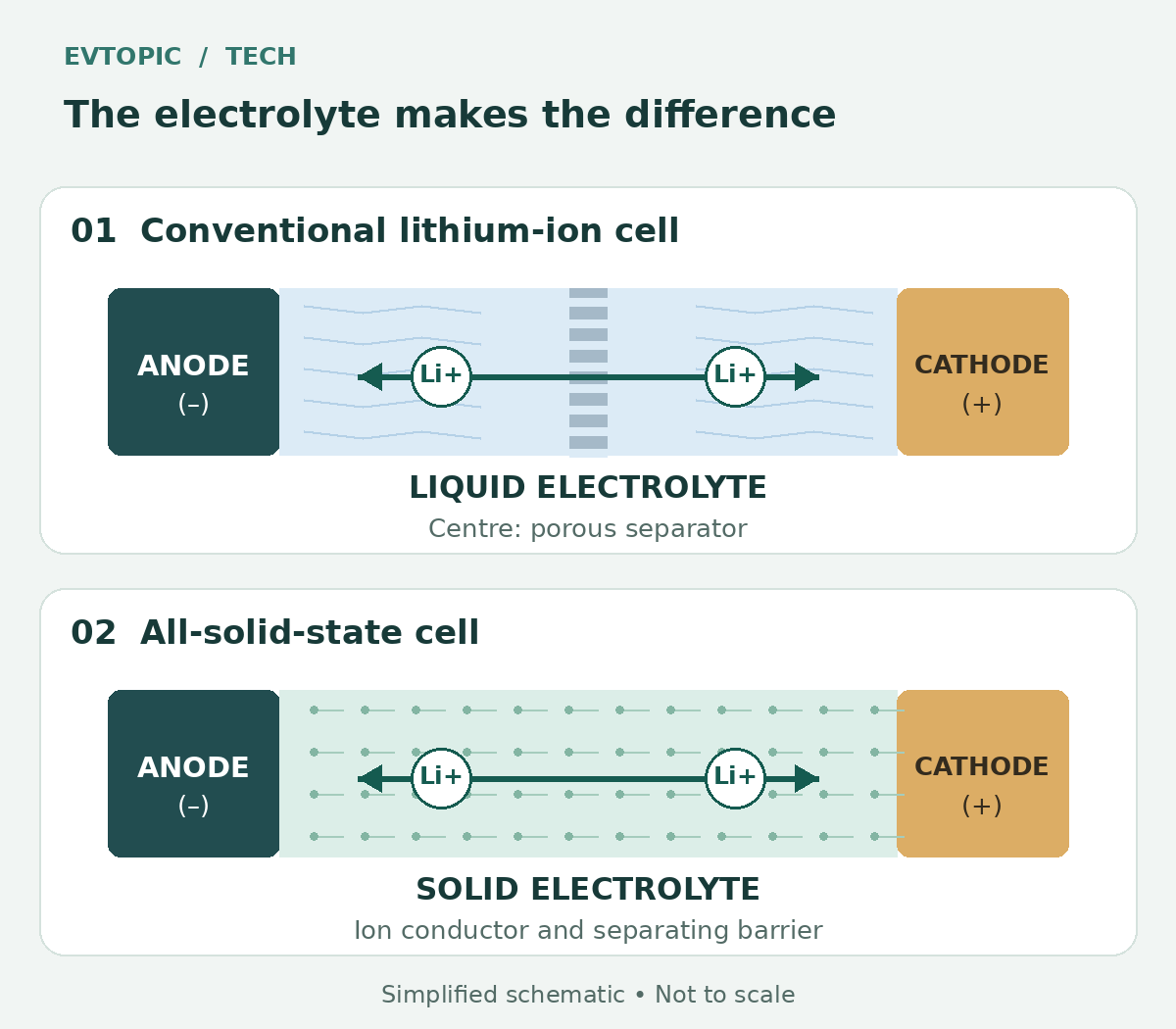
The two electrodes in a typical lithium-ion cell are already solid. A liquid electrolyte carries lithium ions between them, while a porous separator prevents direct electrode contact. Electrons travel through the external circuit, providing electrical energy to the vehicle. Charging reverses these flows. The distinction is between the paths taken by ions and electrons, not between a liquid battery and a solid box. DOE battery explainer.
An all-solid-state cell replaces the liquid electrolyte with a solid ion conductor, which can also provide the separating barrier. A solid structure can contain pathways through which lithium ions move between accessible sites. The whole material does not have to melt for this to happen. Research into those pathways helps explain why the precise material and its temperature matter. DOE: ion motion in a solid.
LFP and NMC describe cathode material families; solid-state describes the electrolyte. These labels answer different questions. A solid-state battery may still shuttle lithium ions, and the term says nothing by itself about cobalt content or whether the vehicle uses a 400- or 800-volt system. Nor does it require a lithium-metal anode: researchers have demonstrated all-solid-state cells with silicon anodes. Fraunhofer material roadmap; primary silicon-anode research.
Several material families, rather than one recipe
Candidates include oxide ceramics, sulfide materials, polymers and combinations of them. Sulfides can conduct ions well but may be sensitive to moisture. Ceramic designs require careful processing to create stable contact with the electrodes. Polymers offer different mechanical properties, while operating temperature remains an important design consideration. A ceramic–polymer composite can itself be fully solid: combining two materials does not necessarily mean adding liquid. Jülich material families; Fraunhofer technology comparison.
Semi-solid and all-solid-state are different claims
Semi-solid, quasi-solid-state and solid–liquid hybrid approaches may retain a liquid component in the ion-conducting system. They can offer practical advantages, but they should not automatically be counted as all-solid-state batteries, or ASSBs. When reading a headline, look for a technical description of the electrolyte rather than assuming every use of “solid-state” means the same construction.
Mercedes-Benz illustrates why this distinction matters. Its EQS road-test announcement identifies Factorial FEST cells and calls the programme solid-state. Factorial itself describes FEST as quasi-solid-state, while its separate Solstice platform is all-solid-state. The road test is meaningful progress, but it does not make those two technologies interchangeable. Mercedes-Benz test announcement; Factorial’s own classifications.
What could drivers gain?
The strongest attraction is higher energy density: more energy for a given mass or volume. Replacing a graphite-based anode with lithium metal is one route to that improvement. This is a change to the cell’s material balance and architecture, not simply the result of making its electrolyte solid. DOE: the opportunity and difficulty of lithium metal.
A manufacturer can spend that advantage on additional range, or retain the range while shrinking the battery. But a cell’s Wh/kg figure is not a pack figure. The enclosure, thermal system, electronics and any compression hardware also count. BMW’s vehicle programme explicitly studies expansion, operating pressure and temperature, showing why integration remains part of the engineering challenge. BMW integration programme.
| Potential benefit | Why it matters | What is not guaranteed |
|---|---|---|
| Higher energy density | More range, or a smaller and lighter pack. | Twice the range in every vehicle. |
| Faster charging | Shorter stops with a suitable cell and system. | Ten-minute charging at any station or temperature. |
| Improved safety characteristics | Less reliance on flammable liquid. | Immunity to fire or internal short circuits. |
| Potentially longer service life | Stable materials may reduce particular degradation mechanisms. | A universal cycle life or lifetime guarantee. |
Fast charging requires adequate ion transport through the electrolyte and across its interfaces with the electrodes. Toyota has targeted 10–80% in ten minutes or less, but that remains a development target for its proposed technology, not a general specification of solid-state cells. Toyota’s charging target.
For an illustrative 80 kWh usable pack, moving from 10% to 80% adds 56 kWh. Doing so in ten minutes requires an average of 336 kW entering the battery, before charger-side losses. The battery, thermal management and charging installation must all support that rate. A solid electrolyte cannot turn an 11 kW home charger into a high-power DC station. These are calculated example values, not measured vehicle performance.
Removing flammable liquid can improve safety characteristics, but the electrodes and the energy stored in the cell still matter. Damage, short circuits and reactions between materials remain relevant. Solid-state does not mean fireproof; safety must be assessed for the actual cell chemistry and complete pack. University of Giessen thermal-safety research.
Why is it still difficult to put into a mass-market car?
Solid surfaces must stay in contact. A liquid can wet a surface and occupy available space. Solid layers cannot continuously rearrange themselves in the same way. Volume changes during cycling can create voids, interrupting ion transport and reducing durability. Researchers have directly observed this loss of contact inside experimental cells. Argonne interface imaging.
Lithium penetration is still a failure mechanism. Deposited lithium can enter cracks in a solid electrolyte and eventually cause an internal short. Stanford’s experiments linked mechanical defects with this process. A material being hard or solid is therefore not sufficient proof that it will block lithium under every operating condition. Stanford research on cracking and lithium intrusion.
Operating conditions depend on the design. There is no universal rule that every solid-state cell performs poorly in the cold, or that every one can fast-charge without preconditioning. Buyers in cold climates need vehicle-specific winter data. Likewise, durability must hold across realistic temperatures and charging patterns; a favourable laboratory cycling result cannot establish every aspect of vehicle service life. Fraunhofer: differing operating requirements.
Manufacturing must deliver consistent cells at high yield. Thin layers need accurate assembly; sensitive materials need controlled handling. Toyota has described work on precise, damage-free stacking, while Nissan is developing more efficient dry-electrode production. Those are practical steps toward scaling, but they also explain why a functioning prototype does not establish a competitive retail cost. Toyota manufacturing development; Nissan electrode production.
When will it reach electric cars?
A road test, a commercial launch and widespread availability are separate milestones. Experimental vehicles already exist, and earlier solid-polymer products mean the entire technology family is not new. The present race concerns competitive automotive deployment of advanced cells with higher energy density. This selected overview uses primary sources checked on 20 October 2026; it is not an exhaustive list of developers. Fraunhofer: earlier polymer production.
| Programme | What the source establishes | How to read the timing |
|---|---|---|
| Toyota / Sumitomo Metal Mining | The October 2025 announcement targets a 2027–2028 market launch for all-solid-state BEVs. | A manufacturer target, without a country-by-country order date or final price. |
| Nissan | The August 2025 release says the pilot line has operated since January 2025; EV launch is targeted by fiscal 2028. | FY2028 is not calendar 2028; Japan’s fiscal year extends into March 2029. |
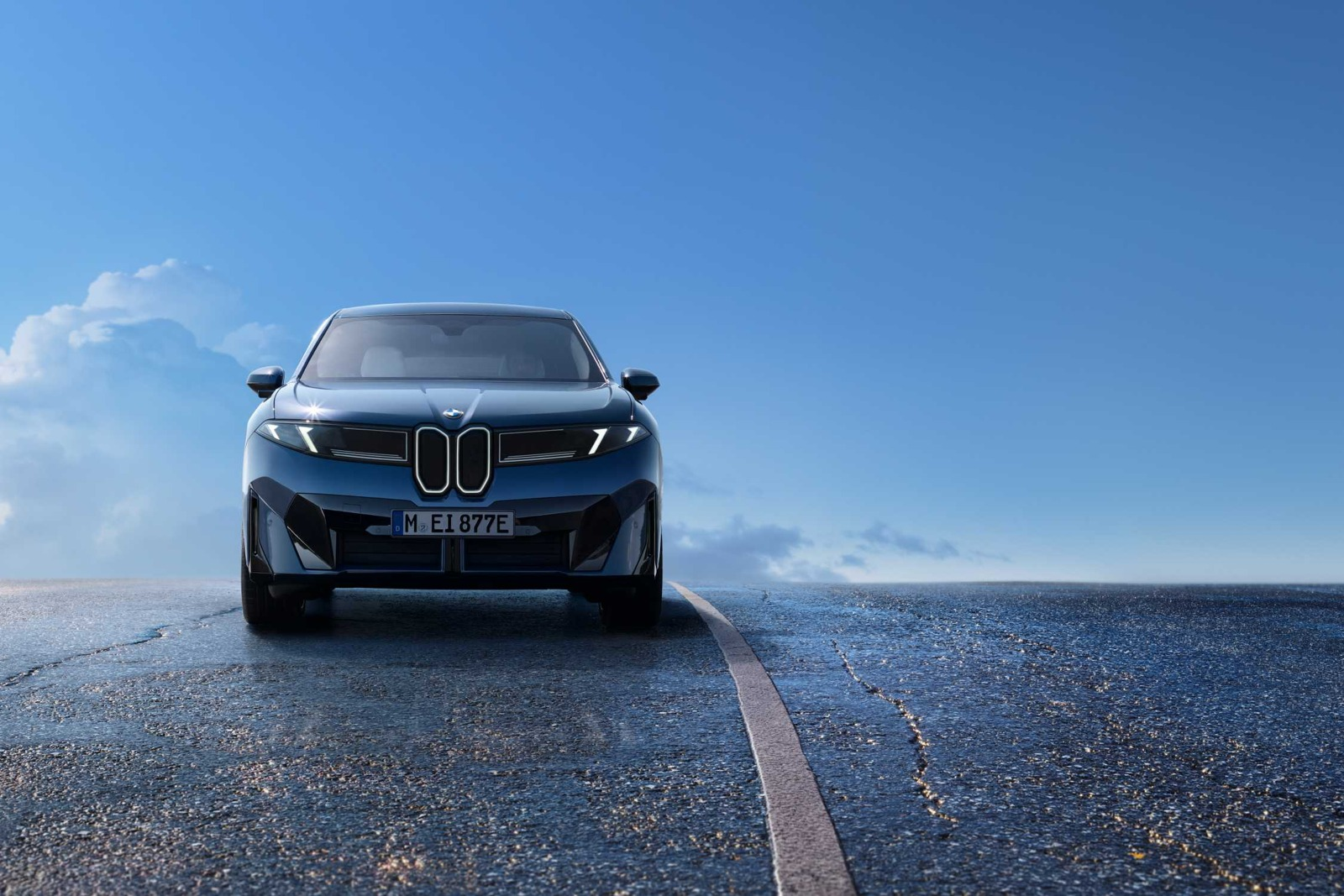
| BMW / Solid Power | In May 2025, BMW reported an i7 road-test vehicle near Munich using sulfide ASSB cells. | A development programme; the announcement gives no on-sale date for a customer model. |
| Mercedes-Benz / Factorial | EQS road tests with FEST cells began in February 2025. | A prototype programme; the supplier calls FEST quasi-solid-state, distinct from all-solid-state Solstice. |
Table sources: Toyota / Sumitomo; Nissan / LiCAP; BMW / Solid Power; Mercedes-Benz; Factorial. The dates describe documented announcements, not independent verification that future targets will be met.
These programmes suggest further introductions toward the end of the decade, followed by a longer industrial ramp. Gradual expansion through the 2030s is an editorial expectation, not a confirmed industry schedule. Conventional liquid-electrolyte batteries are improving too, so future solid-state products will compete against the cost and performance available at launch, rather than against an unchanged benchmark. Toyota’s parallel battery developments.
What does a global launch mean for your market?
A global production announcement does not guarantee simultaneous deliveries everywhere. European and US buyers, for example, need the specifications and availability of the version offered in their own market. The cited programmes do not establish a universal order date or retail price. Regional allocation, model introduction and production capacity must become concrete before a technology target becomes a purchase option.
Should a buyer wait for the technology?
An unspecified future battery is a weak basis for rejecting a vehicle that already meets your needs. Compare the available car’s real-world range, sustained charging performance, home-charging fit, warranty and price. If waiting is practical, the useful milestones are a named customer model, local ordering, independent tests and warranty terms. Those will show how much of the cell-level promise survives in the vehicle you can actually buy.
Solid-state technology opens useful routes to better energy density, charging and safety. The decisive achievement will be combining those gains with durable operation, repeatable manufacturing and a price customers can accept.
Sources17
- DOE — How batteries store and release energy
- DOE — Hops and jumps in a solid-state battery material (23 September 2026)
- Forschungszentrum Jülich — Solid-state battery material families
- Fraunhofer ISI — What will solid-state batteries be like in the future? (2022)
- Fraunhofer ISI — Solid-State Battery Roadmap 2035+ (technical report, 2022)
- DOE — Why is it so hard to make batteries smaller and lighter?
- UC San Diego researchers — Carbon-free silicon anodes with sulfide solid electrolytes
- Argonne APS — X-ray tomography of solid-state battery interfaces
- Stanford — Barrier to next-generation batteries that charge quickly
- University of Giessen — Thermal safety analysis of sulfide solid-state batteries
- Toyota — Monozukuri and solid-state battery manufacturing (2023)
- Toyota / Sumitomo Metal Mining — Cathode-material cooperation (8 October 2025)
- Toyota — Battery technology targets (13 June 2023)
- Nissan / LiCAP — ASSB electrode manufacturing (19 August 2025)
- BMW / Solid Power — All-solid-state cells in an i7 test vehicle (20 May 2025)
- Mercedes-Benz — EQS solid-state battery road tests (24 February 2025)
- Factorial — FEST and Solstice technology definitions