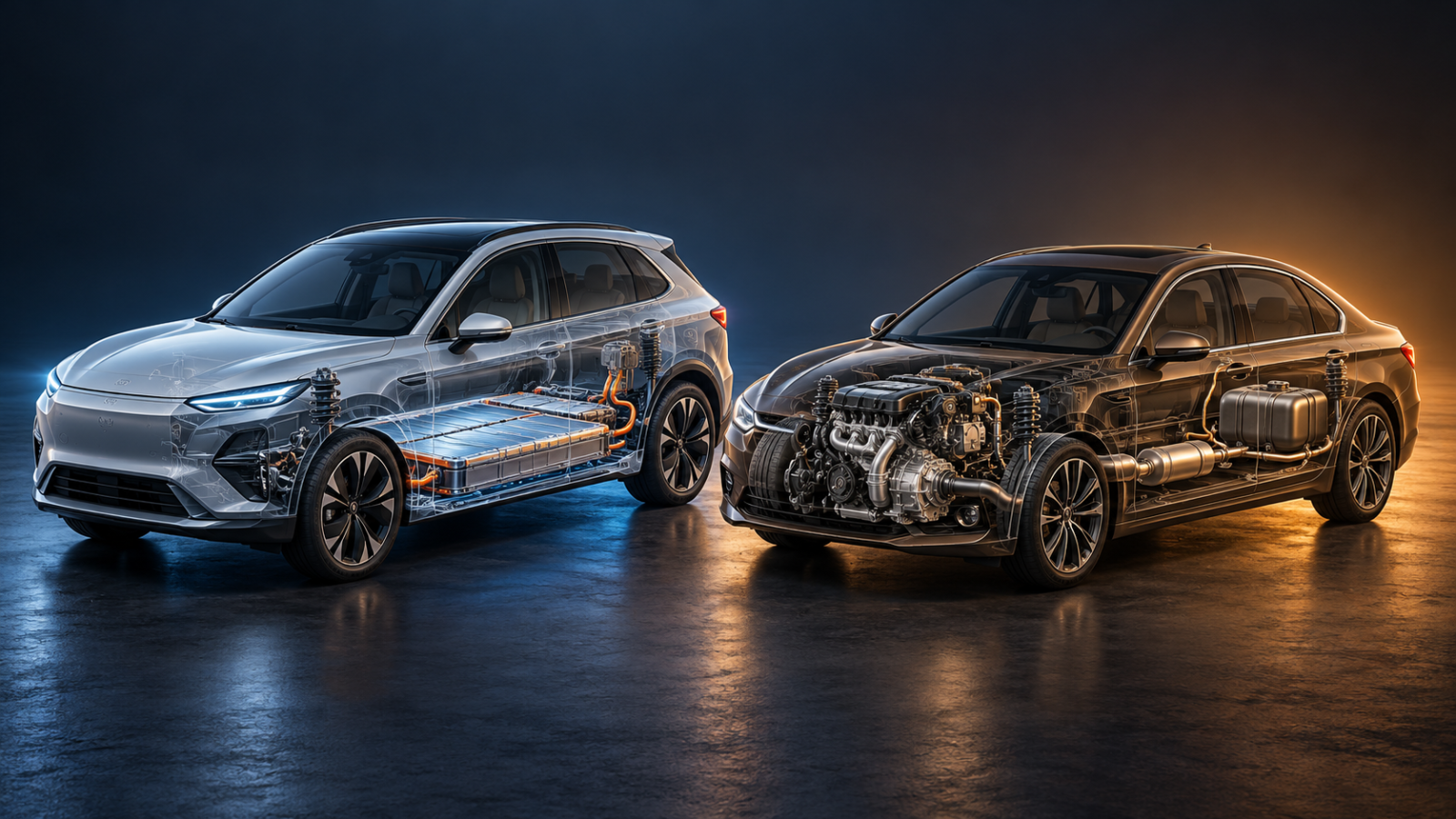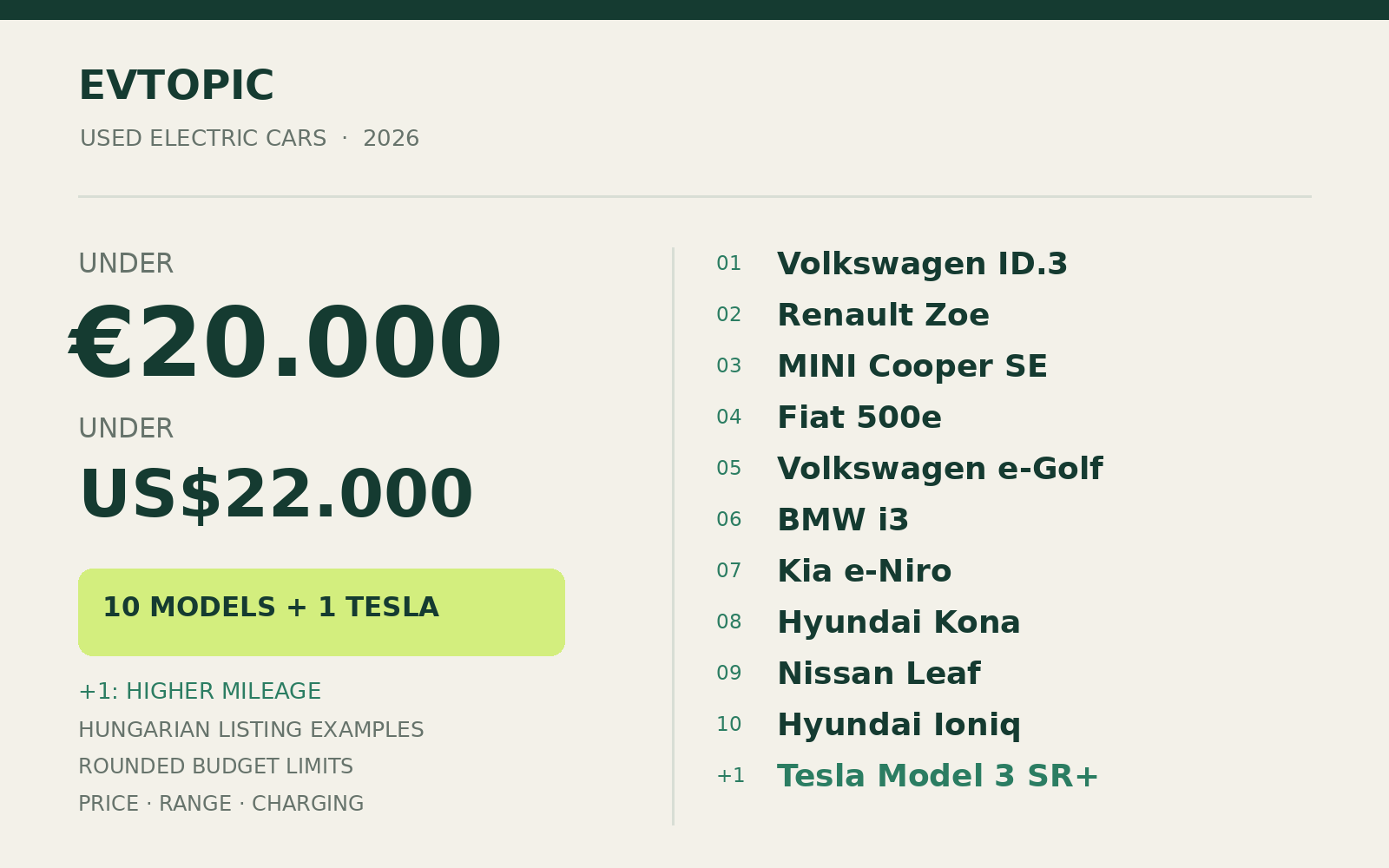
With a budget of €20.000 / US$22.000, a used electric car in Hungary can already be a credible main car for a family. The same budget can buy a fashionable city car, a crossover with a large battery or a newer-generation compact with faster charging. Value depends on how well it fits your journeys — and on the condition of the individual car.
Our shortlist starts with the Kia e-Niro 64 kWh as a family all-rounder, the Hyundai Kona 64 kWh for range and the Volkswagen ID.3 58 kWh for regular longer journeys. Around €13,750 / US$15,410, the Ioniq Electric 28 kWh is an especially interesting commuter. The Zoe, MINI, 500e, e-Golf, i3 and Leaf can make sense with different compromises. A higher-mileage Tesla Model 3 SR+ joins as an optional extra, marked +1 in the tables. These are editorial recommendations by use case, not a reliability ranking.
What can you buy under €20.000 / under US$22.000?
Price snapshot: October 16, 2026. These are individual Hungarian asking-price examples from publicly readable listings. They are not market minimums, averages or completed transactions. Price, availability, condition and mileage must be checked again with the seller; these are not recommendations for inspected cars. Because listing specification fields contained inconsistencies, the technical comparison uses separate data sheets.
Currency conversion: all euro and US dollar amounts are approximate equivalents using the ECB reference rates for October 15, 2026: €1 = HUF 363.60 = US$1.1208. The headline uses rounded editorial ceilings of €20.000 and US$22.000 for readability; they are not exact currency equivalents. Individual vehicle prices are rounded to the nearest €10 or US$10, annual costs and depreciation losses to whole currency units, costs per 100 km to cents and unit energy prices to three decimal places. Calculations use unrounded conversions. These are Hungarian market examples, not local euro-area or US offers; import, transport and registration costs are not added.
| Model / version | Asking price (approx.) | Year/month | Advertised mileage |
|---|---|---|---|
| Nissan Leaf 40 kWh (ZE1) | €11,830 / US$13,250 | 2018/10 | 132,000 km |
| Hyundai Ioniq Electric 28 kWh | €13,610 / US$15,260 | 2018/7 | 118,000 km |
| Volkswagen e-Golf 35.8 kWh (2017–) | €14,150 / US$15,860 | 2019/8 | 121,416 km |
| Renault Zoe ZE50 R135 52 kWh | €15,100 / US$16,920 | 2020/12 | 76,000 km |
| Fiat 500e 42 kWh (EU, 2020–) | €15,920 / US$17,850 | 2022/6 | 41,114 km |
| MINI Cooper SE F56 32.6 kWh | €15,950 / US$17,880 | 2020/3 | 49,700 km |
| BMW i3 120 Ah (BEV) | €17,050 / US$19,110 | 2019/11 | 113,000 km |
| Volkswagen ID.3 Pro Performance 58 kWh | €17,850 / US$20,010 | 2020/11 | 131,904 km |
| Kia e-Niro 64 kWh (first generation) | €17,850 / US$20,010 | 2019/10 | 197,000 km |
| Hyundai Kona Electric 64 kWh (MY20) | €18,120 / US$20,310 | 2020/12 | 154,736 km |
| +1 Tesla Model 3 Standard Range Plus (2019–2020) | €18,430 / US$20,650 | 2019/12 | 172,000 km |
Listing examples: VW ID.3 58, Renault Zoe 52, MINI Cooper SE, Fiat 500e 42, VW e-Golf 35.8, BMW i3 120 Ah, Kia e-Niro 64, Hyundai Kona 64, Nissan Leaf 40, Hyundai Ioniq 28, +1 Tesla Model 3 SR+.
The key lesson is how different the cars behind similar prices can be. The 2022 Fiat is advertised with fewer than 42,000 km; the larger family-oriented e-Niro has almost 197,000 km. The Kia offers space and battery capacity, while its mileage makes condition and warranty checks especially relevant. A lower asking price alone does not establish better value.
Range: how far, and under what conditions?
For consistency, we use EV Database estimates for the versions linked below the table. Mild combined range assumes 23°C without air conditioning; cold conditions mean −10°C with heating. The highway column assumes a constant 110 km/h, not a test at Hungary’s 130 km/h motorway speed. Every figure is a full 100-to-0% range with a battery in new condition, not a test of the advertised car. The cold column is a demanding comparison scenario, not a prediction for every winter day.
| Version | Usable battery when new | Mild / combined | Cold / combined | Cold / 110 km/h |
|---|---|---|---|---|
| VW ID.3 58 | 58 kWh | 400 km | 295 km | 250 km |
| Renault Zoe 52 | 52 kWh | 355 km | 260 km | 220 km |
| MINI Cooper SE | 28.9 kWh | 210 km | 150 km | 125 km |
| Fiat 500e 42 | 37.3 kWh | 270 km | 195 km | 165 km |
| VW e-Golf 35.8 | 32 kWh | 215 km | 160 km | 135 km |
| BMW i3 120 Ah | 37.9 kWh | 275 km | 200 km | 165 km |
| Kia e-Niro 64 | 64 kWh | 430 km | 315 km | 265 km |
| Hyundai Kona 64 | 64 kWh | 450 km | 325 km | 275 km |
| Nissan Leaf 40 | 39 kWh | 275 km | 200 km | 165 km |
| Hyundai Ioniq 28 | 28 kWh | 220 km | 160 km | 135 km |
| +1 Tesla Model 3 SR+ | 49 kWh | 370 km | 265 km | 230 km |
Range and charging data sheets: VW ID.3 58, Renault Zoe 52, MINI Cooper SE, Fiat 500e 42, VW e-Golf 35.8, BMW i3 120 Ah, Kia e-Niro 64, Hyundai Kona 64, Nissan Leaf 40, Hyundai Ioniq 28, +1 Tesla Model 3 SR+.
The kWh figure in a model name is not always usable capacity: the data sheets use 37.3 kWh for the 42 kWh Fiat, an estimated 32 kWh for the 35.8 kWh e-Golf and 28.9 kWh for the MINI. The linked database gives the Leaf 39 kWh usable. These are normalized data-sheet values; an assessment must establish the energy actually available in the car you buy.
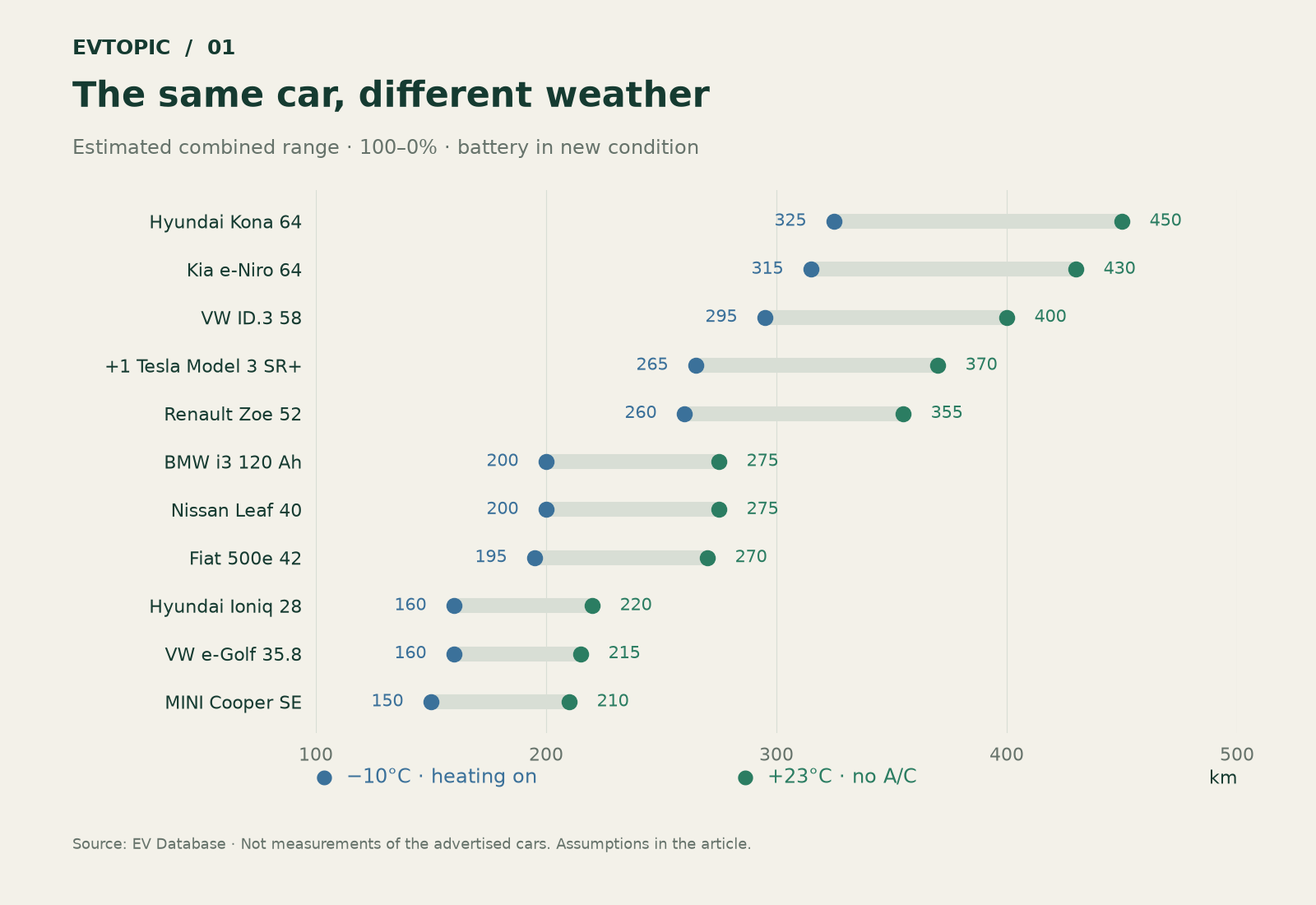
Home and rapid charging reward different cars
AC covers home charging and many street chargers; the car’s onboard charger and available phases set the limit. DC is rapid charging, generally used while travelling. DC peaks and 10–80% times below are EV Database figures for favourable conditions; peak power is brief. The charging station must also meet the car’s power and current requirements.
| Version | AC maximum / phases | DC connector / peak | DC 10–80%, approx. |
|---|---|---|---|
| VW ID.3 58 | 11 kW · 3φ | CCS · ≈124 kW | 34 min |
| Renault Zoe 52 | 22 kW · 3φ | CCS* · ≈46 kW | 56 min |
| MINI Cooper SE | 11 kW · 3φ | CCS · ≈49 kW | 30 min |
| Fiat 500e 42 | 11 kW · 3φ | CCS · ≈85 kW | 25 min |
| VW e-Golf 35.8 | 7.2 kW · 2φ | CCS* · ≈40 kW | 36 min |
| BMW i3 120 Ah | 11 kW · 3φ | CCS · ≈49 kW | 36 min |
| Kia e-Niro 64 | 7.2 kW · 1φ / later 11 kW · 3φ* | CCS · ≈77 kW | 46 min |
| Hyundai Kona 64 | 7.2 kW · 1φ / 10.5–11 kW · 3φ* | CCS · ≈77 kW | 46 min |
| Nissan Leaf 40 | 3.6 / 6.6 kW* · 1φ | CHAdeMO · ≈46 kW | 43 min |
| Hyundai Ioniq 28 | 6.6 kW · 1φ | CCS · ≈69 kW | 19 min |
| +1 Tesla Model 3 SR+ | 11 kW · 3φ | CCS · ≈170 kW | 25 min |
φ indicates the number of phases. Starred equipment is not fitted to every car. Physically check for the two lower CCS contacts on the Zoe and e-Golf. Early e-Niros and Konas generally use one phase; later cars gained three-phase onboard chargers depending on market and equipment. The database rounds the Kona’s manufacturer-rated 10.5 kW to 11 kW. Leaf AC chargers also vary. VIN-specific equipment records and a charging test matter more than a ticked box in an advertisement. Zoe; e-Golf; Kia; Hyundai.
An 11 kW, 3 × 16 A wallbox generally supplies a single-phase car at only about 3.7 kW. Delivering 7.2–7.4 kW on one phase needs roughly 32 A; the Zoe’s 22 kW requires 32 A on three phases. The charger’s headline rating is therefore only part of the answer. Supply capacity, other household loads and load management all matter; have an electrician assess the installation.
Daily use rarely requires an empty-to-full charge. For 50 km a day, battery consumption of 16 kWh/100 km and an assumed 90% charging efficiency, you need about 8.9 kWh from the supply. An idealized calculation gives 3.9 hours at 2.3 kW, 2.4 at 3.7 kW, 1.2 at 7.4 kW or 0.8 at 11 kW. Actual losses depend on the car and charging power. A consistently available, properly installed slower connection can be enough for commuting.
Read charging time together with the distance recovered. The Ioniq 28 can complete 10–80% in about 19 minutes under favourable conditions, but takes on much less energy than the e-Niro in 46 minutes. The 38.3 kWh Ioniq has a different charging profile: its estimated time for the same window is 53 minutes, so a larger battery does not automatically make a better touring car. A cold battery can worsen these results; expect further slowing above 80%. Larger-battery Ioniq data sheet.
Where you charge can change annual costs substantially
The following calculation is not a list of current provider tariffs. It assumes 15,000 km annually and 18 kWh/100 km measured at the electricity meter or charger, including charging losses: 2,700 kWh a year. The table converts the Hungarian article’s illustrative tax-inclusive unit prices into euros and US dollars at the same dated ECB rates. They are not current euro-area or US tariffs; replace them with your bill and chosen charging tariff. Subscription, parking and time-based fees are excluded.
| Charging scenario | Assumed unit price | Energy cost / 100 km | Annual energy cost |
|---|---|---|---|
| Home | €0.193 / US$0.216 per kWh | €3.47 / US$3.88 | €520 / US$583 |
| Public AC | €0.495 / US$0.555 per kWh | €8.91 / US$9.99 | €1,337 / US$1,498 |
| Public DC | €0.770 / US$0.863 per kWh | €13.86 / US$15.54 | €2,079 / US$2,330 |
| 80% home + 20% DC | €0.308 / US$0.345 per kWh average | €5.54 / US$6.21 | €832 / US$932 |
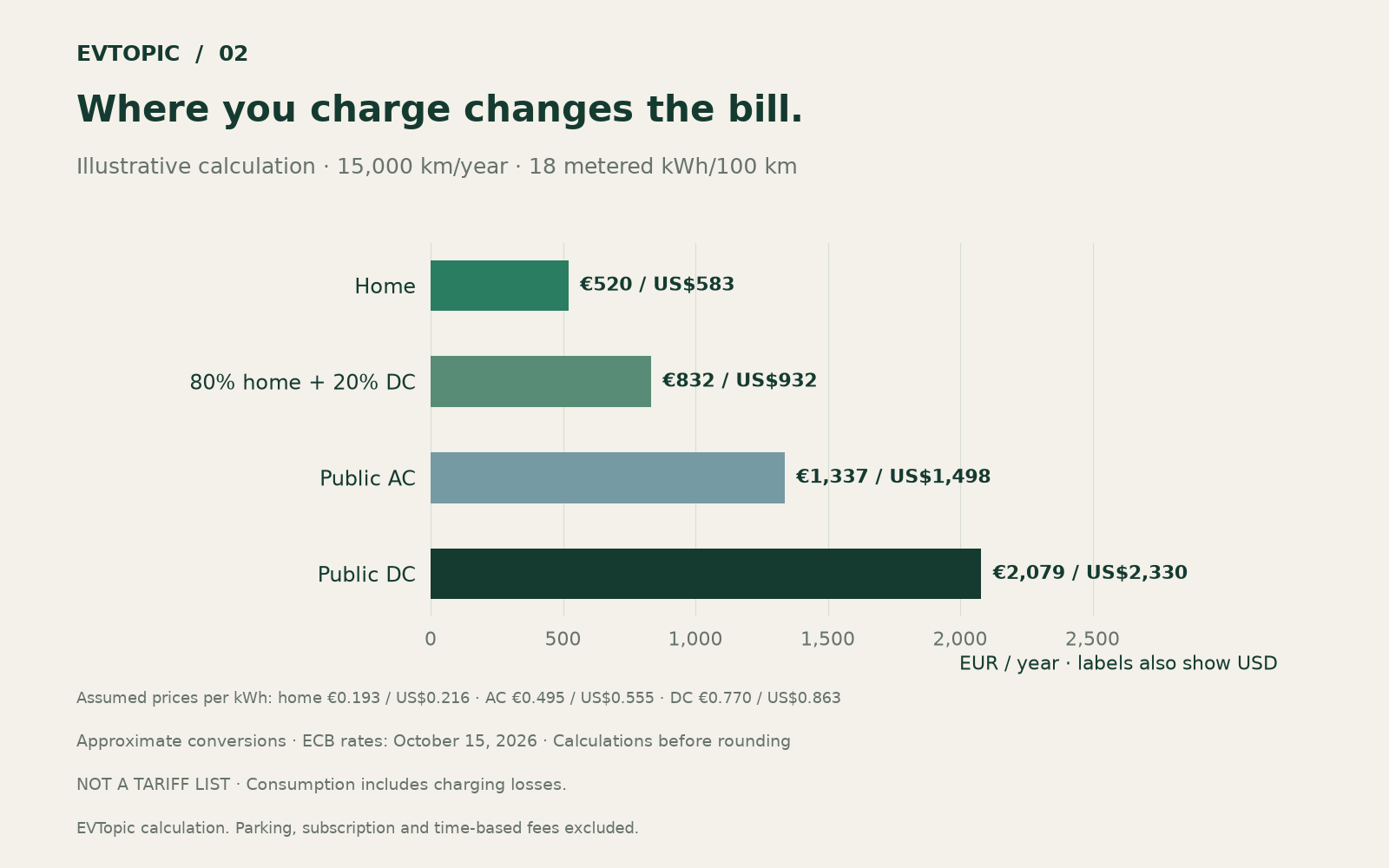
In this example, charging entirely at home versus entirely on DC differs by about €1,559 / US$1,748 a year. Reliable home or workplace charging can therefore matter more than selecting a slightly more efficient model. Without a driveway, the Zoe’s 22 kW AC capability may save time, but does not make public electricity cheap by itself. Do not assume a favourable household electricity price is an unlimited discounted allowance for the car: budget for the household’s total consumption.
Ten models: strengths and things to check
We distinguish a design compromise, a documented service issue and a pre-purchase inspection point. A recall does not mean every car is defective; a forum anecdote is not a failure-rate statistic. The recommendations below assume a healthy battery and a sound history.
Kia e-Niro 64 kWh: our family all-rounder pick
This is our pick when one car must cover many different jobs. Its large battery comes with useful rear-seat and luggage space. With home charging, range can matter more than record-breaking rapid charging. Do not expect the charging pace of a new EV6, however: stops approaching three quarters of an hour are part of the package. The Niro Hybrid and PHEV are different cars, as is the smaller 39.2 kWh e-Niro.
Check: motor and reduction-gear noise during acceleration, regeneration and low-speed driving; AC phase capability; servicing and coolant requirements. Kia’s US ELE234 bulletin documents a diagnostic procedure for drive-unit noise on certain Niro EVs; it is not a recall applying to every Hungarian car. Establish any remaining warranty from documents, mileage and age. Resale argument: family practicality and 64 kWh; high mileage and slower DC charging can work against it. Manufacturer service bulletin.
Hyundai Kona 64 kWh: substantial range, less family space
Start here if range matters more than rear legroom. The first-generation 64 kWh car can be an efficient, capable traveller for two. With child seats and a pushchair, try it against the Niro to judge the tighter space. The cheaper 39.2 kWh Kona belongs to a different range category. A large battery does not automatically mean short charging stops.
Check: battery-recall applicability and completion, and invoices, dates and unit identification if the battery was replaced. Hyundai documented a battery-replacement campaign; model year alone does not establish whether the car you are considering is affected. Listen to the drivetrain, inspect the cooling system and confirm charger equipment. Resale argument: substantial range, while undocumented battery history makes a strong asking price harder to justify. Hyundai statement.
Volkswagen ID.3 58 kWh: for regular longer trips
We consider it one of the strongest touring compromises in the core shortlist, provided you find a healthy car with its software history in order. A spacious cabin, three-phase AC and one of this group’s strongest DC charging capabilities work in its favour. Check the version: the 45 kWh Pure and 77 kWh Pro S are not equivalent. Early cars’ charging curves depend on software and battery condition; the data-sheet peak is not reproducible at every stop.
Check: infotainment, driver-assistance functions, charging schedules, the 12 V battery and factory service campaigns. Volkswagen’s earlier 2.4 package included a new 12 V battery and revised thermal management; request the individual car’s complete update history. Resale argument: 58 kWh, CCS and 11 kW AC; competition from later cars with improved software and faster charging may put pressure on prices. Volkswagen service information.
Hyundai Ioniq Electric 28 kWh: the sensible commuter
Around €13,750 / US$15,410, we would definitely compare it with the e-Golf. Efficiency, five-door practicality and strong DC charging for a small battery are its appeal. Your daily journey should sit comfortably below the range it can reliably cover in cold weather. Long motorway trips require more frequent stops; short charging sessions do not replace a large battery.
Check: that it is the 28 kWh Electric, not a hybrid or plug-in hybrid; test AC and DC charging, heating and air conditioning, and listen to the drivetrain. Battery age still matters. We are not asserting a proven widespread defect affecting every example. Resale argument: an accessible purchase price and efficiency; short winter and highway range narrow its next-buyer audience.
Renault Zoe ZE50: strongest when you rely on AC
It can make sense without home charging if you have reliable access to a 22 kW AC point. Charging during work or in the evening can then be more convenient than with single-phase rivals. DC charging on longer journeys is slower, though, and a car without CCS brings a substantial travel compromise. Do not confuse the 52 kWh ZE50 with earlier 22 or 41 kWh Zoes.
Check: battery ownership, CCS, charging, motor-bearing noise and air conditioning. ADAC identifies motor-bearing and air-conditioning-compressor issues across the Zoe family, plus power electronics on early cars. Separately, the facelifted Zoe received zero stars in Euro NCAP’s 2021 assessment; the old five-star result belongs to a different test. Resale: owning the battery and having CCS strengthen the case. ADAC; Euro NCAP.
Volkswagen e-Golf: familiar-car appeal
It suits buyers who simply want an electric Golf. Familiar controls and a useful five-door body come with modest range and roughly 40 kW DC charging. We focus on the 35.8 kWh version introduced in 2017; earlier small-battery cars involve different compromises. In our snapshot, the similarly priced Ioniq charges faster, while familiar ergonomics and the condition of individual cars may favour the Golf.
Check: CCS, whether a heat pump is fitted and works, heating, charge-port locking, brakes and suspension. ADAC’s Golf VII report gives reasons to inspect brakes, springs and dampers; we do not interpret that as an e-Golf-specific failure rate. Resale: familiarity can help, but a car priced too close to an ID.3 is harder to justify. ADAC used-car report.
Fiat 500e 42 kWh: a balanced city-car choice
Among the small city cars, this is our first choice if rear-seat space is not essential. More usable battery capacity than the MINI, 11 kW AC and useful CCS charging form a good combination. We mean the European 42 kWh generation built from 2020: older US-import 500es and the European 24 kWh car are different propositions. With four seats and a small boot, choosing one as a family’s main car needs careful thought.
Check: the 12 V battery, fault codes, charging initiation, door operation, heating and infotainment. These are inspection points, not proven defects on every car. ADAC’s own long-term test also illustrates the limitations of winter/highway use and the small boot. Resale: 42 kWh and CCS improve usability, but a premium paid for styling is not guaranteed to return at sale. ADAC long-term test.
MINI Cooper SE: driving enjoyment with short range
We would buy it as a second car for short daily journeys and enjoyment. The older F56 SE is a distinctive compact option, but 28.9 kWh usable leaves limited scope for winter motorway driving. The similarly priced Fiat offers more range in this comparison. Choose the MINI because you enjoy the test drive and the brand experience, not to maximize range for your money. The newer generation introduced from 2024 uses different technology.
Check: completion of battery-related campaigns, the 12 V system, charging and suspension. US recall 24V-612 covers the high-voltage system and software on certain 2020–2024 SEs; for a Hungarian or imported car, a dealer VIN check determines what applies. Resale: character can attract buyers, while the small battery and greater usability of the newer generation may constrain pricing. Official recall document.
BMW i3 120 Ah: a distinctive city car with distinctive compromises
The fully electric 120 Ah is the i3 version we would target within this budget. Ah is not kWh: the data sheet gives this version 37.9 kWh usable energy. It feels light and manoeuvrable in town, but seats four and its rear doors deserve a test in a tight parking space with child seats. The 60 Ah, 94 Ah and petrol range-extender REx versions are different choices.
Check: tyre prices and wear, suspension, air conditioning, heating and documentation of previous accident repairs. For a damaged car with its carbon-fibre passenger cell, we would involve someone experienced with the i3. ADAC highlights tyre wear and the door arrangement’s compromises. Resale: distinctiveness may support demand, but does not make the i3 an investment; the 120 Ah’s usability is a stronger argument than hoping for collector status. ADAC.
Nissan Leaf 40 kWh: affordable commuting with clear limits
We would consider the Leaf at a meaningful discount and with home charging available. Our example costs substantially less than the large-battery crossovers while remaining a useful five-door car. However, a CHAdeMO-equipped Leaf cannot rapid-charge directly from a CCS cable: check working CHAdeMO locations on your actual routes. The larger battery in a 62 kWh e+ does not turn it into a CCS car.
Check: battery health, cell imbalance and behaviour under load; the dashboard capacity bars alone are insufficient. Nissan itself warns that successive rapid charges can take longer because of battery temperature. Resale: connector and long-distance limitations may narrow the future buyer pool. At similar condition and price, we would therefore choose a suitable CCS-equipped alternative. Nissan charging note; Inspection guidance.
+1 optional candidate: Tesla Model 3, with higher mileage
A Tesla can fit below €20.000 / US$22.000. Our example, checked on October 16, 2026, is a December 2019 Model 3 Standard Range Plus with 172,000 km, advertised at approximately €18,430 / US$20,650 using this article’s exchange rates. We include this rear-wheel-drive version as an optional extra among affordable used Teslas, without claiming the absolute lowest asking price across the brand. Its higher mileage is central to the buying decision. The individual listing.
What does it offer? The early European SR+ has an estimated 49 kWh usable battery, with 370 km mild combined, 265 km cold combined and 230 km cold highway range at 110 km/h in our comparison. 11 kW three-phase AC, CCS and Superchargers support everyday use, with a favourable 25-minute 10–80% estimate. These figures assume a new-condition battery, not the advertised car. This NCA version has no heat pump and differs from later LFP Model 3s. EV Database data sheet.
Repair reserves matter alongside the purchase price. Have the suspension, control arms, brakes, lights and battery underside inspected; test heating, air conditioning and both AC and DC charging. ADAC’s Model 3 report specifically highlights brakes, lighting and suspension. Our example exceeds the SR+ battery and drive-unit warranty’s 160,000 km limit: do not assume remaining cover simply because the car is under eight years old. Check the original vehicle-specific terms and any separate warranty on replacement components. ADAC; Tesla warranty information.
Who is it for? Buyers who specifically want a Model 3, value its charging options and can retain a repair reserve after purchase. For resale, brand recognition and documented battery health can help, while high mileage, expired warranty and competition from newer versions may constrain the price. A healthy SoH figure is useful evidence, but does not establish the condition of the entire car. A Tesla near the budget ceiling is therefore an optional candidate that deserves a particularly thorough inspection.
Resale: the next buyer also needs a usable car
There is no sound basis here to promise a selling price three years from now. Our current listing sample is not a longitudinal price study and cannot establish depreciation rates. The following table is an editorial assessment of features that can help or hinder resale. New-car discounts, import supply and technological progress can reprice the whole group.
| Model group | What may support resale | What may constrain the price |
|---|---|---|
| e-Niro / Kona 64 | Large battery and range suited to varied use | High mileage, slower DC, unclear repairs |
| ID.3 58 | CCS, 11 kW AC, spacious cabin | Early software reputation, stronger newer rivals |
| Zoe 52 | Owned battery, 22 kW AC, confirmed CCS | No CCS, battery-lease obligations, safety compromise |
| Ioniq 28 / e-Golf 35.8 | Accessible purchase price, everyday practicality | Shorter cold/highway range; missing CCS on some Golfs |
| 500e 42 / MINI SE / i3 120 | Character and city usability | Small boot/four seats; especially short range in the MINI |
| Leaf 40 | Low price and useful commuting ability | CHAdeMO, battery health and repeated-DC limitations |
| +1 Tesla Model 3 SR+ | Brand recognition, CCS/Supercharger, documented battery health | High mileage, warranty limits, repairs and newer-version price competition |
Calculate depreciation in cash as well. A hypothetical 20% decline on a car costing about €13,750 / US$15,410 is about €2,750 / US$3,083; a hypothetical 15% decline on a car costing about €17,880 / US$20,040 is about €2,682 / US$3,005. The car doing better in percentage terms loses almost the same amount of cash. These percentages illustrate arithmetic, not forecasts; conversions are rounded only after calculation. Add electricity, insurance, servicing, tyres, charging installation and any finance costs to purchase price minus eventual resale value.
Five checks before buying
-
An independent battery assessment. SoH, test method and date, fault codes and cell imbalance; ideally available energy and a load test. A seller’s “100% battery” statement is not a test report.
-
AC and DC charging tests. Use the correct connector and a charger with known capability; record charge level and temperature. A low peak from a cold battery is not a diagnosis by itself.
-
VIN and history. Servicing, accident repairs, completed recalls, battery replacement and exact remaining warranty terms; battery ownership matters on the Zoe too.
-
Inspect the whole car. Brakes, tyres, suspension, underbody/battery enclosure, heating, air conditioning and the 12 V system. A simple electric motor does not remove these costs.
-
Try your actual use case. Child seats, luggage, parking space, winter commute and available chargers. A healthy smaller car that fits can be better value than stretching to a larger one at the budget limit.
Before travelling: what can a VIN reveal?
For a car located abroad, bought from a company fleet or repossessed by a lender, the seller may not know its full history or every option. Ask for the 17-character VIN before arranging a viewing. Based on the two services’ public descriptions and the VAG service’s sample reports, the following information can supplement the advertisement.
Tesla: equipment and a dated SoH estimate
The servicehistorybyvin.com Tesla lookup offers VIN-based factory configuration, equipment and available battery-capacity and SoH information. According to the provider, a vehicle data sheet requires the VIN and an email address, without a Tesla account. You can therefore start checking a car located abroad from home, without being physically beside it. Model, drivetrain, interior and Autopilot-package information can be compared with the advertisement.
Check the estimate date when judging how current the SoH is. A report retrieved today does not necessarily contain a battery estimate made today: the provider distinguishes the estimate date from the retrieval date. Data varies by VIN, so guaranteed live SoH coverage for every vehicle and country cannot be assumed. Read the percentage alongside usable kWh and its date, then supplement it with a pre-purchase inspection. Data availability and terms.
VAG: service history, mileage records and factory equipment
For Volkswagen, Audi, Škoda, SEAT and CUPRA, vwidcheck.com analyses available electronic service documentation. Its report includes dates, recorded odometer readings and work performed, plus plain-language explanations of documented factory campaigns and recalls. For an ID.3 or e-Golf, this helps you ask specific questions: is there a service-interval discrepancy, which campaigns involved the car, and what completion evidence is recorded? The public sample report illustrates interval discrepancies and campaign explanations.
For battery-warranty questions, this is a useful starting point, not a warranty certificate. An apparently late entry or a missing record warrants follow-up, but alone does not prove missed maintenance or loss of cover. Check invoices, the vehicle-specific service interval and the position with the authorised service centre. VWIDCheck itself says it does not assess warranty validity and requires owner or authorised-party status for the request.
An original factory vehicle data sheet and equipment list can also be ordered separately, with a readable summary. The equipment sample report includes factory PR codes, original market specification and technical details. This is especially useful for overseas, fleet or repossessed cars: heat-pump equipment, heated seats, assistance packages or charging specification can be checked in greater detail than an advertisement may provide. The factory list describes the original configuration; inspect the equipment’s current presence and operation, plus any later modifications, when viewing the car.
Which would we buy with our own money?
| If your priority is… | Start your search with… |
|---|---|
| One family car, with home charging | Kia e-Niro 64 kWh; also ID.3 58 |
| Range matters more than rear-seat space | Hyundai Kona Electric 64 kWh |
| Regular longer journeys with DC stops | Volkswagen ID.3 Pro Performance 58 kWh |
| Commuting around €13,750 / US$15,410, home charging | Hyundai Ioniq Electric 28; e-Golf 35.8 as an alternative |
| Reliable access to 22 kW AC | Renault Zoe ZE50 with an owned battery, preferably CCS |
| A compact second car for the city | Fiat 500e 42; MINI SE or i3 120 Ah for character |
| Low purchase price, short predictable trips | A thoroughly checked Leaf 40 at a meaningful discount |
| +1: a Tesla within budget, accepting higher mileage and a repair reserve | Model 3 Standard Range Plus; VIN, battery and full condition checks |
If we had to give one starting point, it would be a healthy e-Niro 64 kWh, with an ID.3 58 viewed on the same day. If you will not use a large battery, there is no need to spend the full €20.000 / US$22.000 budget: a suitable Ioniq or e-Golf can leave money in your pocket. The best value ultimately comes from a car you can charge conveniently, that covers your winter journeys and passes a thorough pre-purchase inspection.
Sources45
- Használtautó.hu — Volkswagen ID.3 Pro Performance 58 kWh
- EV Database — Volkswagen ID.3 Pro Performance 58 kWh
- Használtautó.hu — Renault Zoe ZE50 R135 52 kWh
- EV Database — Renault Zoe ZE50 R135 52 kWh
- Használtautó.hu — MINI Cooper SE F56 32,6 kWh
- EV Database — MINI Cooper SE F56 32,6 kWh
- Használtautó.hu — Fiat 500e 42 kWh (EU, 2020–)
- EV Database — Fiat 500e 42 kWh (EU, 2020–)
- Használtautó.hu — Volkswagen e-Golf 35,8 kWh (2017–)
- EV Database — Volkswagen e-Golf 35,8 kWh (2017–)
- Használtautó.hu — BMW i3 120 Ah (BEV)
- EV Database — BMW i3 120 Ah (BEV)
- Használtautó.hu — Kia e-Niro 64 kWh (első generáció)
- EV Database — Kia e-Niro 64 kWh (első generáció)
- Használtautó.hu — Hyundai Kona Electric 64 kWh (MY20)
- EV Database — Hyundai Kona Electric 64 kWh (MY20)
- Használtautó.hu — Nissan Leaf 40 kWh (ZE1)
- EV Database — Nissan Leaf 40 kWh (ZE1)
- Használtautó.hu — Hyundai Ioniq Electric 28 kWh
- EV Database — Hyundai Ioniq Electric 28 kWh
- Használtautó.hu — +1 Tesla Model 3 Standard Range Plus (2019–2020)
- EV Database — +1 Tesla Model 3 Standard Range Plus (2019–2020)
- ADAC — Renault Zoe used-car report
- ADAC — Used electric cars: equipment and battery ownership
- Euro NCAP — 2021 Renault Zoe assessment
- ADAC — BMW i3 used-car report
- ADAC — Volkswagen e-Golf used-car report
- ADAC — Fiat 500e long-term test
- Hyundai — February 2021 EV battery recall
- Kia — ELE234 drive-unit inspection bulletin
- NHTSA / BMW — MINI Cooper SE recall 24V-612
- Volkswagen — ID. software 2.4 and 12 V battery
- Hyundai — Kona Electric November 2020 technical data
- Kia — e-Niro equipment sheet
- Nissan — Leaf brochure and charging limitations
- EV Database — Ioniq Electric 38.3 kWh
- ADAC — Buying a used electric car
- ADAC — Tesla Model 3 used-car report
- Tesla — Vehicle warranty, Hungary
- ServiceHistoryByVIN — Tesla VIN, equipment and SoH
- ServiceHistoryByVIN — Terms and data availability
- VWIDCheck — Service history and factory equipment
- VWIDCheck — Public service-analysis sample
- VWIDCheck — Public factory-equipment summary sample
- ECB — Euro foreign exchange reference rates, 2026-10-15